LinkedIn / case study
← All selected workA reporting model becomes a product.
Semantic modelling, PBIP/TMDL documentation and Power BI architecture for multi-domain commercial reporting.
01 / Context
The question behind the work.
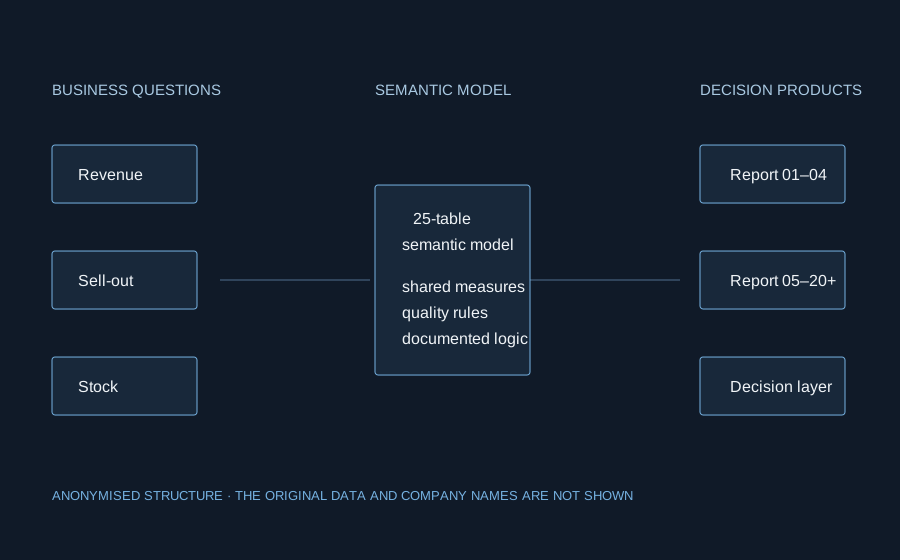
Commercial reporting needed a shared model across sell-out, sell-in, stock, product, POSM, marketing and store KPIs. The challenge was discoverability and governance as much as visualisation.
02 / Built
Structure before decoration.
Worked with a version-controlled Power BI project, semantic model documentation, model maps, DAX measures, relationships, keys and role-based access concepts. The documented model contains 114 tables, 67 business tables, 235 measures, 118 relationships, 25 RLS roles and 70 report pages.
03 / Result
What changed.
The work makes a complex BI product easier to navigate, explain and extend. It supports a stronger engineering story: versioned models, explicit definitions, documentation and governed access rather than isolated dashboards.
Continue